Quebec’s Law 25 Explained: What Businesses and Email Users Need to Know

Last updated: November 20, 2026
A staff member signs up for a free analytics trial on a Tuesday. By Thursday the tool is collecting visitor data on your website, including the email addresses people type into your contact form. Nobody asked where that data is stored, and nobody wrote down who approved it.
That ordinary week is where Quebec Law 25 lives. It's the province's modernized privacy law, and it doesn't stop at banks and hospitals. It reaches the bakery with an online order form, the software company with Quebec clients, and any employer running payroll for staff in the province.
The short version: Law 25 sets rules for how you collect, use, keep and share personal information, and it expects you to show your work. This guide walks through what the law requires, where it differs from PIPEDA, and which everyday email and vendor choices trigger obligations you can't skip.
What Is Quebec Law 25 and When It Took Effect
Quebec Law 25 is the province's modernized privacy statute, enacted as Bill 64. It governs how organizations collect, use, disclose, retain and destroy personal information, and it applies to public bodies as well as private businesses.
What catches people out is the calendar. Law 25 didn't switch on all at once. Its obligations arrived in three stages, which is why two businesses can both claim compliance while operating to very different standards.
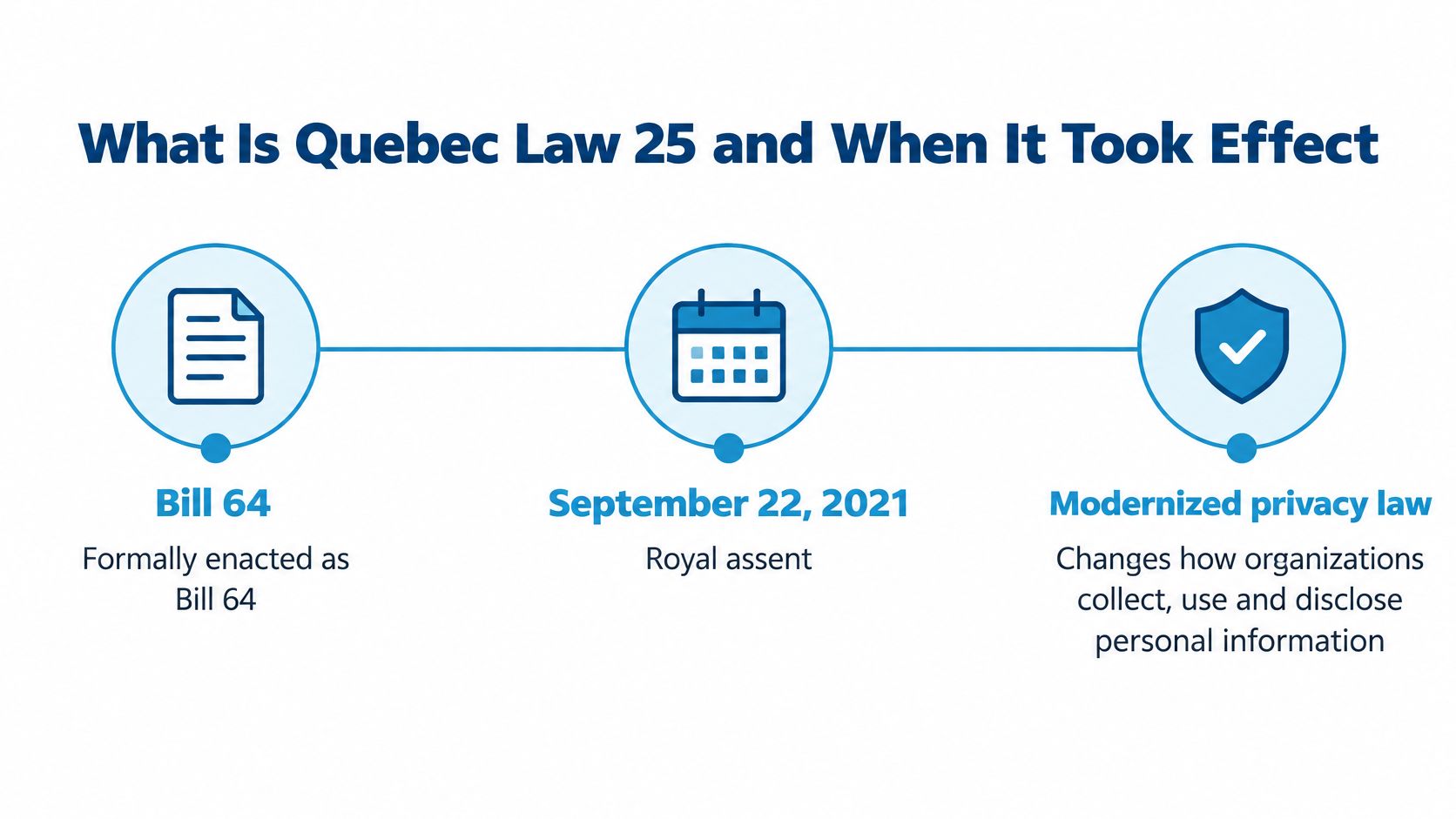
Bill 64 received royal assent on September 22, 2021, and its obligations rolled out in three stages beginning September 22, 2022, according to the Quebec government. From that first date, organizations had to designate a person in charge of protecting personal information, keep a register of confidentiality incidents, and notify the Commission d'accès à l'information (CAI) and affected individuals when an incident presents a risk of serious injury.
Stage two took effect on September 22, 2023. It brought stronger consent rules, disclosure duties for automated decisions, privacy impact assessments and assessments before certain transfers of information outside Quebec. The final scheduled milestone arrived on September 22, 2024, when the data portability right became applicable.
| Stage | Date | What started applying |
|---|---|---|
| Stage 1 | September 22, 2022 | Privacy officer designated; confidentiality incident register; breach notification to the CAI and affected individuals |
| Stage 2 | September 22, 2023 | Consent rules; automated-decision notices; privacy impact assessments; assessments before transfers outside Quebec |
| Stage 3 | September 22, 2024 | Right to data portability applies |
Why the phase-in matters more than any single deadline
Treat that timeline as an operations schedule, not a legal footnote. Each stage maps to a different part of your business. Stage 1 is governance and incident response. Stage 2 is product design and vendor management, because adopting a new analytics tool or moving email hosting to a provider outside Quebec is exactly the kind of change that can trigger a privacy impact assessment. Stage 3 is how you respond when a customer asks for their data in a portable format.
A policy drafted in 2022 and never revised won't answer a question about the analytics trial someone started last Tuesday.
The same logic applies inside the law. Public bodies must run a privacy impact assessment for projects that acquire, develop or overhaul an information system handling personal information, and the depth of that assessment has to match the sensitivity, purpose, quantity, distribution and storage medium of the data involved. Private organizations meet the same expectation whenever they build something new or move data across a border.
Practical rule: If nobody can produce the record behind a privacy decision, that decision is difficult to defend.
Which Organizations Must Comply With Law 25
Small business owners often assume Law 25 is aimed at companies with in-house counsel. Nothing in the law sets a size threshold. If you handle personal information while carrying on an enterprise in Quebec, the duties attach, whether you have four employees or four thousand.
That single sentence resolves most of the confusion, but the edges are worth walking through.
Where the line actually sits
Two questions do most of the work. Are the people whose information you hold in Quebec? And do you carry on an enterprise there? If the answer to both is yes, the law reaches you. Here's how that plays out in common situations.
A bakery in Quebec City with an online order form. Covered. Customer names, delivery addresses and order notes are personal information, so the shop needs a named privacy officer, a published contact, and a register for incidents.
An Ontario software company with Quebec clients. Usually covered for the Quebec client data it holds, especially where it sells into the province or has staff or infrastructure there. Hiring a Canadian vendor doesn't move the duty off your desk.
A nonprofit collecting donations from Quebec residents. The answer turns on whether its activity counts as an enterprise, which is where fundraising meets commercial activity. This is the scenario where you want a lawyer's read before you decide.
A Quebec employer running payroll. Covered for employee information, not just customer data. Staff files, payroll records, benefit details and work email accounts all count.
The employer situation is the one people miss most often. Teams spend weeks on customer-facing notices and forget that the HR folder sitting in a shared drive is full of the same category of information.
The honest limitation is that "carrying on an enterprise" isn't defined with perfect precision for every business model. A company with no Quebec office, no Quebec staff and one Quebec customer may sit outside it. A company with a Quebec sales rep may not. When the facts are murky, pay for an hour of legal advice rather than guessing.
Consent to a tool isn't the same as a lawful basis for the collection behind it. Ask why you need the data before you ask whether people agreed to it.
Three questions you can answer today: whose personal information do we hold, where is it stored, and who inside the company is named as accountable for it?
Key Privacy Rights and Business Duties Under Law 25
Law 25 is built as a trade. Individuals get rights over their own information, and organizations get a matching set of duties that make those rights real. Miss the duties and the rights become theoretical.
Start with what the law is protecting. Personal information means anything that identifies a person directly or indirectly. A name beside an email address. An IP address in a server log. An order history tied to a customer number. If you can connect a data point to a human being, treat it as personal information and let the duties follow.
The duties, one row at a time
Most summaries list obligations without saying who they land on. This table fixes that.
| Obligation | What the organization must do | Who it affects |
|---|---|---|
| Privacy officer | Designate the person in charge of protecting personal information and publish the title and contact details | All private-sector organizations |
| Confidentiality incident register | Record every incident involving personal information, with the risk assessment and steps taken | All organizations handling personal information |
| Breach notification | Notify the CAI and affected people when an incident presents a risk of serious injury | All organizations handling personal information |
| Consent | Obtain clear, specific consent for each purpose, with extra care for sensitive information | Organizations collecting personal information |
| Privacy by default | Set tracking, profiling and location features to off by default in technology offered to the public | Products and services offered to the public |
| Privacy impact assessment (PIA) | Assess privacy risks before acquiring or building a new system or service, and before sending personal information outside Quebec | Projects involving personal information |
| Automated decisions | Tell people when a decision is made exclusively by automated processing, and explain it on request | Organizations using automated decision systems |
| Access, correction and portability | Respond to access requests, correct inaccurate information, and provide data in a structured, commonly used format | Individuals who make requests |
| De-indexation | Stop disseminating personal information or de-index it where its circulation causes serious harm | Individuals who make requests |
Privacy by default is easiest to picture with hardware. Think of a smart thermostat that ships with its motion sensors off until the owner deliberately turns them on. Now apply the same instinct to software: a customer portal that starts with profile sharing disabled, or an email platform that doesn't load remote images and tracking pixels unless you allow it.
The Quebec government's announcement on the Law 25 provisions coming into force confirms the governance layer: organizations must establish privacy policies and practices and publish them in clear language. A PIA is also required before communicating personal information outside Quebec, which turns data location, vendor access paths, encryption and retention into operational controls rather than policy statements. The same guidance treats destruction of personal information as an obligation once the purpose of collection is fulfilled, which means retention schedules have to cover mailbox content, metadata, logs, backups and dormant accounts.
That's the takeaway worth pinning up. Every row in the table should point to a record someone can produce on request, and every record should have a date and an owner attached.
How Law 25 Differs From PIPEDA
Here's the practical answer. Quebec's private-sector law governs most commercial handling of personal information inside Quebec. PIPEDA is Canada's federal private-sector privacy law, overseen by the Office of the Privacy Commissioner of Canada (OPC), and it applies to commercial activity across the country where no substantially similar provincial law applies.
In Quebec, the provincial private-sector privacy act, as modernized by Law 25, is that substantially similar law. That's why the provincial rules, not the federal ones, set the day-to-day standard for Quebec-facing work.
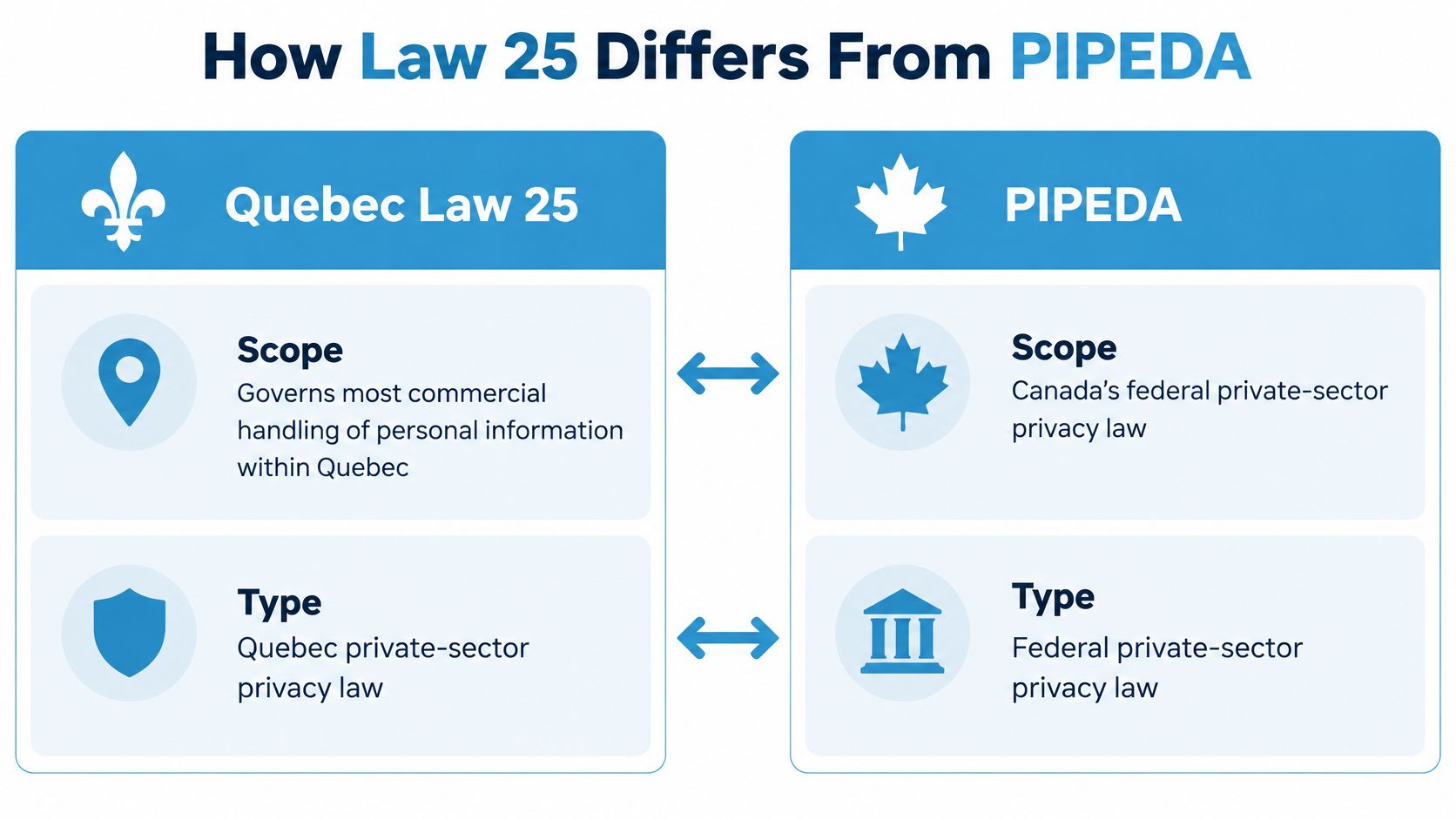
| Feature | Law 25 (Quebec) | PIPEDA (federal) |
|---|---|---|
| Scope | Private-sector organizations carrying on business in Quebec | Commercial activity across Canada, except where a substantially similar provincial law applies |
| Privacy officer | Must be designated, with the title published | Must designate an individual accountable for compliance |
| Breach reporting | Report to the CAI and individuals when there is a risk of serious injury; keep an incident register | Report to the OPC and individuals when there is a real risk of significant harm; keep records of all breaches |
| Regulator | Commission d'accès à l'information (CAI) | Office of the Privacy Commissioner of Canada (OPC) |
| Automated decisions | Specific notice and explanation duties | No equivalent provision |
| Data portability | Right in force since September 22, 2024 | No equivalent right |
| Transfers outside Quebec | PIA required before communicating personal information outside Quebec | Organizations remain accountable for information transferred to third parties |
Why the gap shows up on a Tuesday afternoon
The two regimes differ in style as much as substance. PIPEDA leans on accountability: you're responsible for the data you hold, including when a third party processes it for you, and you demonstrate that responsibility through your practices. Law 25 spells out steps. Sending contact records to a support vendor outside Quebec triggers a documented assessment before the transfer happens.
The differences also stack. Many organizations operate under both regimes at once, which is exactly why the comparison matters for planning. A Montreal firm with customers in Ontario answers to Law 25 for its Quebec data and to PIPEDA elsewhere. An email provider and its customer can also answer to different rules. A Quebec business stays responsible under Law 25 for the client files in its mailbox, whichever provider hosts them. Two regimes can apply to one file.
Our reading, by situation
This part is our assessment as a practitioner, not legal advice. If your business operates only in Quebec, build your program to Law 25 and treat PIPEDA as background. If you operate in several provinces, treat Law 25 as the higher bar for Quebec residents and let that standard drive your vendor reviews, because a control that satisfies Quebec usually satisfies the federal baseline too.
For the federal side in more depth, our guide to PIPEDA compliance for Canadian businesses covers the accountability model, breach reporting thresholds and the record-keeping expectations that sit alongside it.
Enforcement, Penalties and Complaint Trends
Take a company with CAD 800 million in worldwide turnover. Under Quebec’s private-sector privacy act, the CAI can impose an administrative monetary penalty of up to CAD 10 million or 2% of worldwide turnover for the preceding fiscal year, whichever is higher. Penal fines, pursued through prosecution, can reach CAD 25 million or 4% of worldwide turnover, again taking the higher amount.
Run the math on that CAD 800 million business. Two percent of turnover is CAD 16 million, which clears the fixed ceiling without effort.
The percentage is what makes the numbers bite. Once an organization earns meaningful global revenue, the turnover figure becomes the limit that matters, and the dollar ceiling works like a floor rather than a cap.
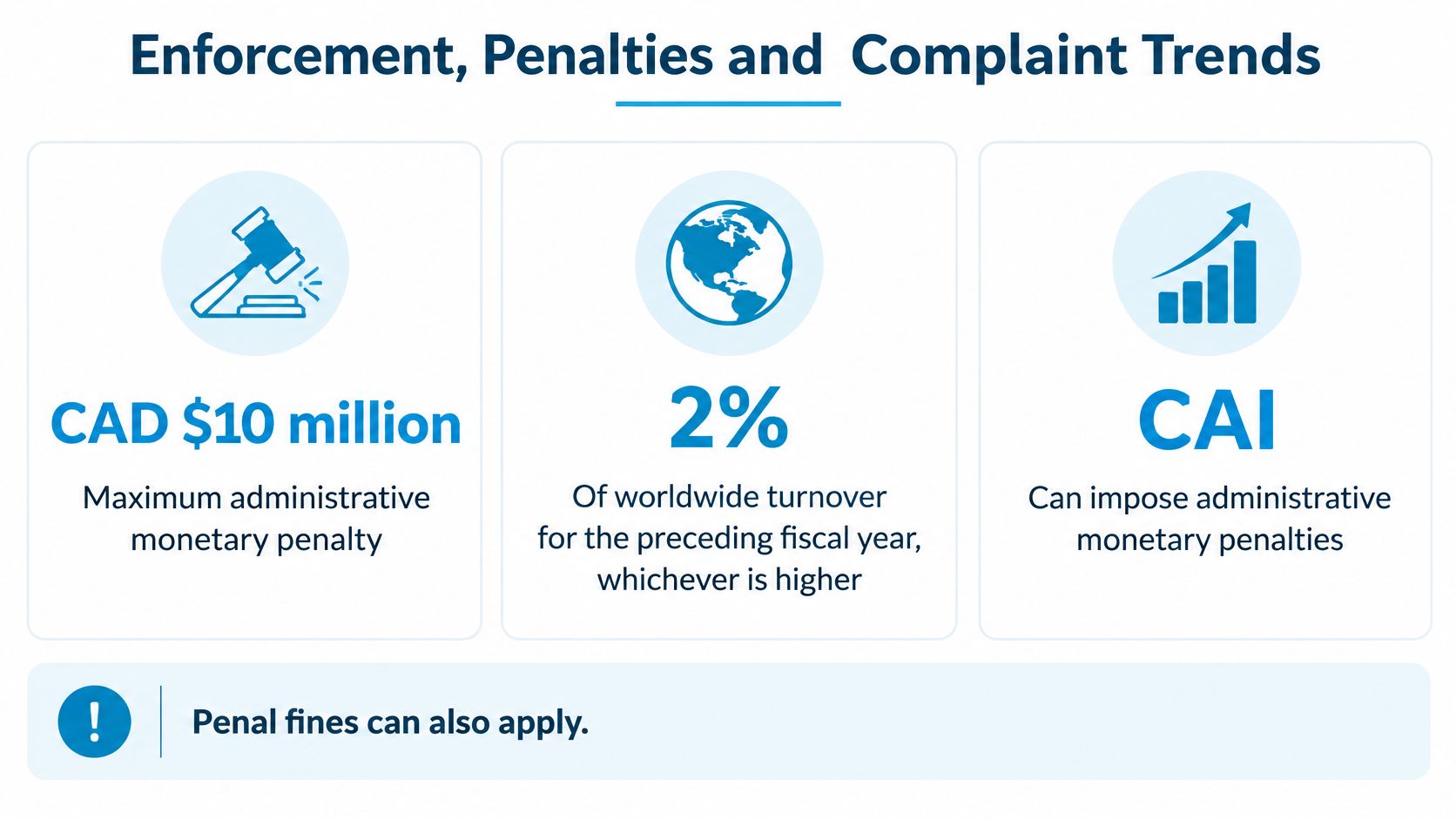
| Penalty type | Maximum | Imposed by | Scope |
|---|---|---|---|
| Administrative monetary penalty | CAD 10 million or 2% of worldwide turnover, whichever is higher | Commission d'accès à l'information (CAI) | Specified contraventions |
| Penal fine | CAD 25 million or 4% of worldwide turnover, whichever is higher | Court, on prosecution | More serious offences |
The overview below walks through how these two tracks fit together in practice.
What the complaint numbers say
Penalties get the headlines, but the daily reality is a steady flow of files. The CAI received 514 confidentiality-incident notices in its 2024–2025 reporting year, up 16%, and 80% came from the private sector. The most common causes were cyberattacks, human error and ransomware. Complaints climbed faster still.
They rose from 277 in 2023–2024 to 549 in 2024–2025, a 98% year-over-year increase, according to the CAI’s 2024–2025 annual report. Of those complaints, 364 were directed at businesses.
The files behind those numbers usually begin with routine decisions: a new tracker added to the website, a vendor that starts handling customer records, a mailbox retention setting nobody revisits. That is a working caseload.
How a complaint actually moves
An individual files with the CAI. The Commission reviews what the organization did, asks for records, and can order corrective measures. Most of that conversation turns on documentation: what you collected, why, who could see it, how long you kept it, and what you did when something went wrong.
A fine isn't automatic, and the size of one depends on how serious the failure was, how long it lasted, whether it's a repeat, and how the organization responded once it knew. The same records that carry you through the review shape that penalty discussion, so a prompt, documented response often matters more than the size of your legal budget.
Email and Communications Obligations Under Law 25
Email is the largest store of personal information in most businesses, and almost nobody counts it that way. Inboxes, attachments, contact lists, calendar invites, server logs and backups all hold names, addresses, health details and financial records. A retention policy that covers your CRM but skips your mail store leaves a large share of personal information unmanaged.
When an ordinary forwarded email becomes an incident
An office manager forwards a client's tax file to a colleague for review. The colleague's laptop is stolen that evening. That sequence can be a confidentiality incident, meaning unauthorized access to, use of, or loss of personal information.
Law 25 asks for more than fixing the technical problem. According to the Quebec government's notice on the new Law 25 provisions, the organization must keep a register of all confidentiality incidents and act promptly to reduce the risk of harm. Where the incident presents a serious risk of harm, it must notify both the CAI and the affected individuals.
The trigger is risk, assessed before anyone proves the data was misused. A stolen laptop that was encrypted and locked is a different file from an unencrypted one with client tax records on the desktop, and your register should say which one you're dealing with.
A workable entry records what happened, which personal information was involved, who may be affected, your risk assessment, and the mitigation steps you took. Write it the same week, not the same quarter.
Tracking pixels, marketing mail and consent
A tracking pixel is a tiny invisible image embedded in an email that reports back when the message is opened. It ties an open event to a person, often to an IP address and a rough location. That's personal information being collected, so it needs transparency, and in most cases consent.
The same logic applies to routine tooling changes. Turning on open-rate tracking for a newsletter, adding a marketing platform, or switching email providers each alters what gets collected and where it goes. Run the privacy assessment before the rollout, because retrofitting one after launch means the collection already happened.
If you run campaigns to Quebec subscribers, keep the tracking honest and the unsubscribe path obvious. Our explainer on CASL, Canada's anti-spam law, covers the consent and identification rules that sit alongside the privacy duties, and the two regimes are usually assessed together.
Practical rule: If a feature exists to observe the reader, it belongs in your privacy notice.
Retention, backups and what metadata reveals
Mailboxes, metadata, logs, abuse records, backups and inactive accounts all need a schedule and an enforced deletion step. "We keep everything forever in case someone asks" is a decision, and it's a hard one to defend.
One trade-off matters when you pick a provider. Encryption protects the content of a message, but metadata such as sender, recipient, subject line and timestamps often stays visible to the provider so it can route and filter mail. When you evaluate a provider, ask what they can see, not just what they encrypt.
Jurisdiction is part of that answer. Typewire stores inboxes, attachments, contacts and metadata on privately owned Canadian servers under PIPEDA, so the whole mail store sits inside one legal system. That simplifies both the retention schedule and the incident assessment when something goes wrong.
How to Prepare for Law 25
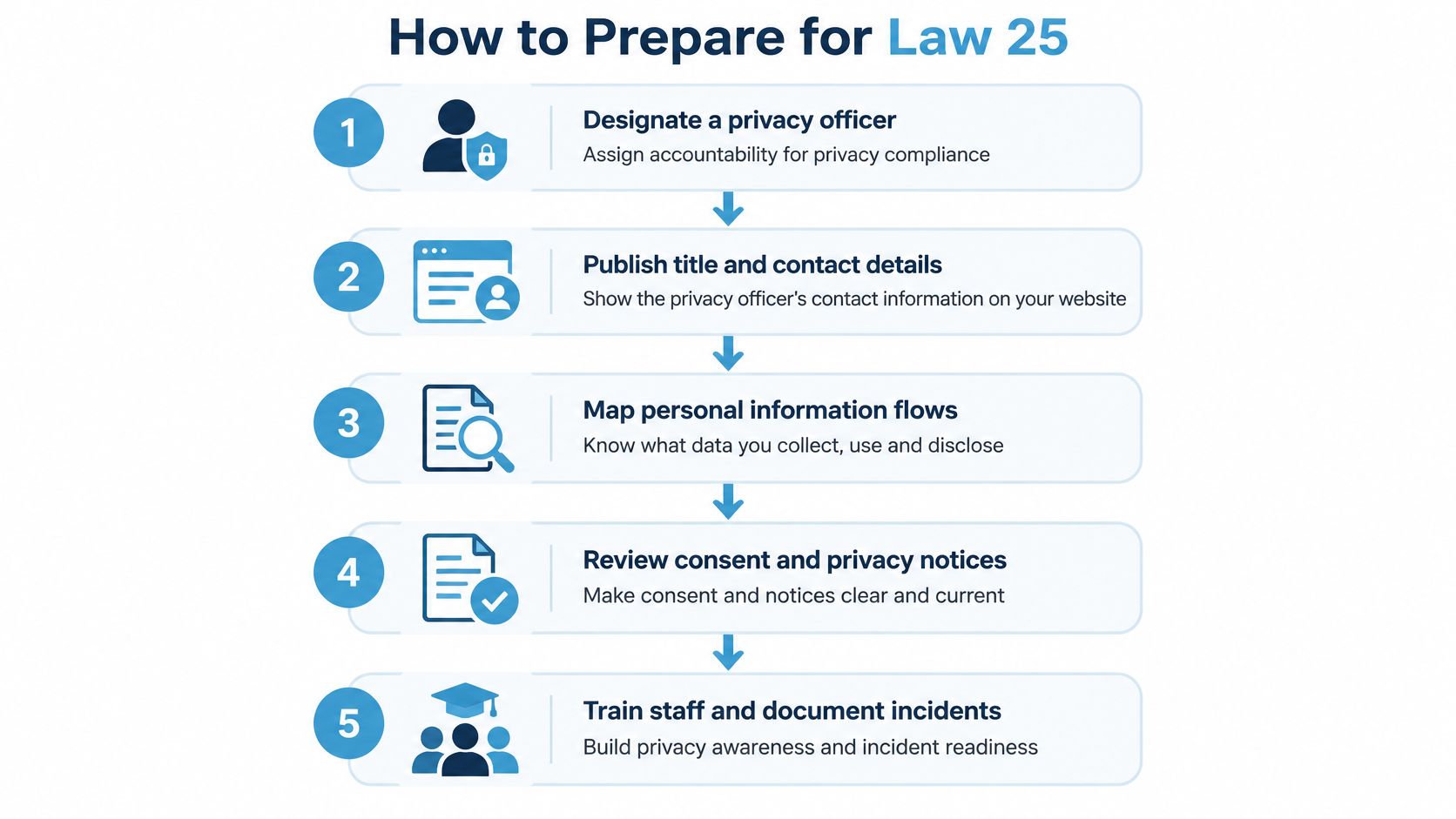
You don't need a twelve-month program to get to a defensible position. You need a short list of steps done in order, each with a name attached.
Designate a privacy officer and publish the title and contact details on your website. This role anchors every other control, because someone has to own the register, the assessments and the access requests.
Map where personal information lives. Email, customer software, payroll, analytics, support tickets and backups. You can't assess what you haven't located.
Run a PIA for each new tool, vendor replacement and feature update, and before sending information outside Quebec. Ask the vendor where data is stored, which subprocessors touch it, who has administrator access, how it's encrypted, and how deletion works.
Set public-facing products to the most private settings by default. Regulators care about defaults because few users ever change them.
Open an incident register and write a response playbook. Include the risk assessment step and the notification decision, so the first hour of an incident isn't spent inventing a process.
Write a retention schedule for mailboxes, logs, backups and inactive accounts, then enforce it with automatic deletion rather than good intentions. If you're starting from scratch, these email retention policy best practices cover the practical mechanics.
Build an access request process with a 30-day response window. Decide now who verifies identity, who pulls the records and who signs the answer.
Review the whole program once a year, and again after every new tool or vendor change. Tools change faster than policies do.
A note on vendor claims: "Hosted in Canada" answers a location question. It doesn't answer the purpose, access, retention or transfer questions a PIA is designed to surface.
We're Typewire, a private email provider based in Vancouver, BC. We store customer data only on Canadian soil and operate under PIPEDA, with every part of your email, inboxes, attachments, contacts and metadata, on privately owned Canadian servers. Residency is a useful starting point for a Quebec buyer, and nothing more. Ask the harder questions rather than taking a location claim on faith.
Frequently Asked Questions About Law 25 Compliance
Q: Does hosting our data in Canada make us compliant?
A: No. Residency is one input among several. Law 25 still expects documented purposes, working access controls, retention rules, contract terms with processors, and an honest answer about whether support staff outside Quebec can reach the data. A Canadian server that half a dozen people in three countries can log into doesn't buy you much.
Q: Can we deploy facial recognition if we get consent?
A: Probably not on consent alone. Quebec's regulator has pushed back on biometric systems in practice, including a December 2024 CAI decision ordering an organization to stop using facial recognition for employee access control, and a February 2025 decision reportedly blocking a retailer's loss-prevention pilot, as Access Privacy's summary of the regulator's first decisions reports. Our reading is that consent doesn't resolve necessity and proportionality. That's interpretation, not a legal ruling.
Q: How fast must we answer an access request?
A: Generally within 30 days of receiving it. The clock starts when the request arrives, not when it reaches the right person, so route requests to a monitored address and log the date. If you can't answer in time, respond with the reason and the timeline rather than going quiet.
Q: Does monitoring employee email require a PIA?
A: In most cases, yes. Employee information is personal information, and a system that reads, indexes or retains message content is a technology system collecting it. Document the purpose, the scope of what's captured, who can review it, and whether a less intrusive option, such as logging metadata only, would do the job.
If your compliance checklist stops at the email layer, that's the part we can help with. Typewire keeps inboxes, attachments, contacts and metadata on infrastructure we own in Canada, with no ad tracking and no data mining, so the retention and access questions above have a concrete answer. Start your 7-day Typewire free trial and check the email side of this checklist against a live account.
The post Quebec’s Law 25 Explained: What Businesses and Email Users Need to Know appeared first on Typewire.
Quebec’s Law 25 Explained: What Businesses and Email Users Need to Know
Posted: 2026-11-24
Man-in-the-Middle Attacks: How Hackers Intercept Your Email in Transit
Posted: 2026-11-20
Data Sovereignty in Canada: Why Where Your Email Is Stored Matters
Posted: 2026-11-17
What Is Email Spoofing? How Attackers Fake Your Sender Address
Posted: 2026-11-13
Should You Get a Custom Domain for Personal Use?
Posted: 2026-11-10
Who Writes Typewire’s Code? People.
Posted: 2026-11-07
Zero-Day Attacks Explained: What They Are and Why Your Email Is a Target
Posted: 2026-11-06
Dark Web Monitoring: How to Check If Your Email Was Exposed in a Data Breach
Posted: 2026-11-03
What Is Credential Stuffing and How Does It Threaten Your Email Account?
Posted: 2026-10-30