Data Sovereignty in Canada: Why Where Your Email Is Stored Matters
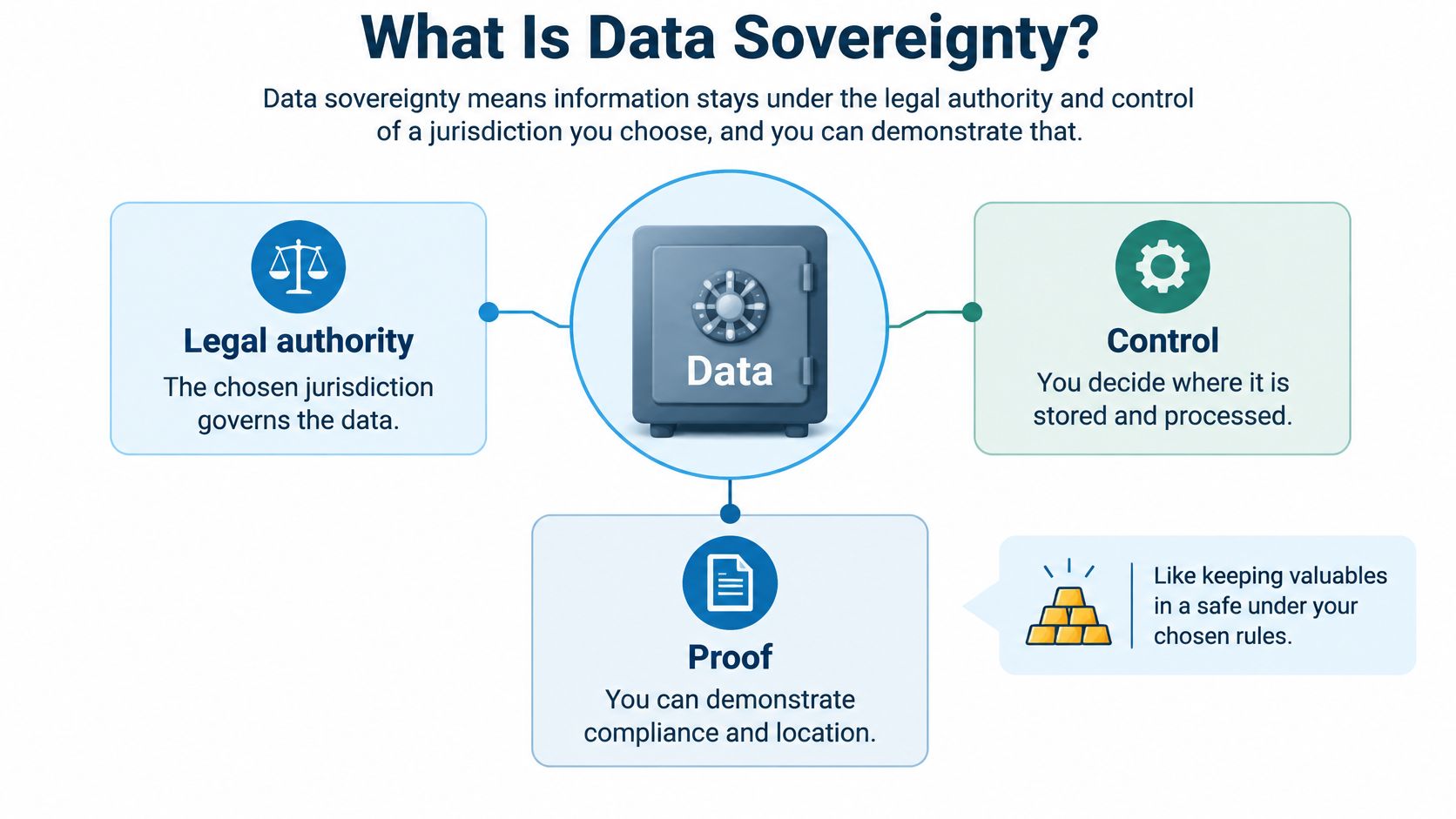
Data sovereignty is the principle that your data stays under the legal authority and control of the jurisdiction you choose, and that you can show it in practice. Storing email in Canada does not automatically meet that test.
The popular advice to choose a local data centre leaves important questions unanswered. Who owns the provider? Who can open a mailbox? Where do recovery copies go during an outage?
At Typewire, we think those answers matter more than a flag on a website. For your email, the practical goal is to connect storage location, legal authority and operational control to written evidence.
What Is Data Sovereignty?
Think of a safe sitting in one country while a company in another country holds its combination. Knowing where the safe stands doesn't tell you who can open it, or which court can order that company to act.
Email works much the same way. A mailbox has a physical location, but its provider also has owners, administrators and legal obligations.
Three separate questions
The Government of Canada's white paper on data sovereignty and public cloud explains that sovereignty depends on institutions' ability to control and protect information under domestic jurisdiction, not just its storage address. It warns that foreign laws may still reach infrastructure hosted in Canada when the provider falls under another country's authority.
Data residency describes where information sits at rest. Legal jurisdiction concerns which laws govern the organizations handling it, including a parent company. Operational control concerns the people and systems that can administer accounts, recover information or use encryption keys.
Residency, jurisdiction and control compared
| Term | Question it answers | Email example |
|---|---|---|
| Data residency | Where is the data physically stored? | Mailboxes stored on servers in Vancouver, BC |
| Legal jurisdiction | Which country's laws can compel access? | Provider's parent company is subject to foreign law |
| Operational control | Who can administer systems and hold encryption keys? | Foreign-based support staff with admin access to mailboxes |
These examples describe different aspects of the same service. A provider can give a clear answer about server location while leaving ownership and administrator access unclear.
Proof makes the distinction useful
A meaningful assessment follows both message content and metadata. Metadata includes information such as sender addresses, recipients and message timing. Even when someone can't read a message, those details can reveal business relationships.
Encryption-key custody deserves its own answer. If the provider can recover a key and decrypt stored messages, encryption doesn't remove that provider from your access assessment.
Practical rule: Ask where the information lives, whose laws reach its custodian, and who can operate the system. Don't accept one answer as a substitute for the others.
You don't need to inspect every server yourself. You need a documented chain of custody, with contracts and technical explanations that agree. A reassuring sales answer isn't enough when the service agreement allows something broader.
Canada's Data Sovereignty Landscape
A procurement questionnaire can stall a deal before any technical work begins: where does the supplier's data live, and under whose law? Sovereignty has moved from a government-technology concern to an ordinary purchasing question.
CIRA’s annual survey of cybersecurity decision-makers shows how mainstream this question has become. In 2026, 67% said data sovereignty matters more than price when choosing a cybersecurity vendor, close to 69% in 2025. Another 91% said it’s important that their cybersecurity data and records are stored and processed in Canada. In the past year, 41% reviewed, reduced or replaced a US or other foreign vendor over trade, political or sovereignty concerns.
Key figures on data sovereignty demand
| Source and year | Figure | Scope of the study |
|---|---|---|
| CIRA cybersecurity survey, 2024 | 60% chose data sovereignty over price | Cybersecurity decision-makers in Canada |
| CIRA Cybersecurity Survey, 2025 | 69% chose data sovereignty over price, including 71% in the private sector | Cybersecurity decision-makers in Canada |
| CIRA Cybersecurity Survey, 2026 | 67% chose data sovereignty over price | Cybersecurity decision-makers at organizations with 50+ employees |
| CIRA Cybersecurity Survey, 2026 | 91% said it’s important that cybersecurity data and records stay in Canada | Cybersecurity decision-makers at organizations with 50+ employees |
| CIRA Cybersecurity Survey, 2026 | 41% reviewed, reduced or replaced a foreign vendor in the past year | Cybersecurity decision-makers at organizations with 50+ employees |
CIRA surveyed organizations with 50 or more employees, not small-business owners, and asked about cybersecurity vendors rather than email. Still, the questions larger buyers ask travel down the supply chain, so a smaller supplier should expect to hear them during vendor reviews.
Buyer expectations can exceed legal requirements
A client can require domestic storage even when privacy law permits an international processing arrangement. A contract can go further and restrict remote access, backup locations or subcontractors. PIPEDA sets a baseline for handling personal information; a customer's procurement policy can build well above that baseline.
Say you run a design studio handling confidential product plans. The client's procurement team asks where your email attachments live before anyone discusses the design work. Your choice of provider now decides whether you can sign.
Not every mailbox needs the same restrictions. A public enquiries inbox and an inbox holding employee medical records call for different assessments.
Start with obligations. Read client confidentiality terms and identify any sector-specific requirements.
Match controls to sensitivity. Decide which information needs stricter storage, access and recovery arrangements.
Record acceptable exceptions. If a service processes something abroad, document why you accept that arrangement.
Define the requirement before you choose the provider. If your promise to a client requires data held on Canadian servers under Canadian law, a provider storing all mail and metadata on privately owned Canadian servers under PIPEDA, as Typewire does, can meet it. A convenient service that stores or processes that data elsewhere cannot.
Why Data Residency Matters for Email
Your inbox may contain contracts, invoices, tax forms, client records and password-reset messages. It becomes a filing cabinet without anyone deliberately designing it that way.
Say a small accounting firm receives client tax documents by email. The owner sees a domestic-hosting claim and assumes it covers every copy. A separate backup service or attachment scanner could make that assumption wrong. Location claims apply only to the systems they describe.

Last updated: November 11, 2026
Follow the message beyond the inbox
Start with the primary message store and attachments. Then ask about contacts and search indexes, which help the service find information quickly. A search index deserves review because it can contain information derived from message content.
Next, trace spam filtering, malware scanning and telemetry, the diagnostic information systems collect about their operation. Does a separate vendor receive attachments? Do error logs include addresses or message fragments? Where does that vendor process them?
Finally, examine backups and failover copies. Failover means switching to another system when the main service becomes unavailable, so the recovery location matters most when normal operations break down.
Residency works as a technical control for sensitive information: keeping primary storage, backups and processing infrastructure in Canada can reduce foreign-jurisdiction exposure. It answers the “where” question on its own. Overseas administrators and cross-border support can still create access paths, which means the “who” and “how” questions stay open until you check them separately.
Email protocols don't settle location
Internet Message Access Protocol, or IMAP, lets an email app access and synchronize a mailbox. Simple Mail Transfer Protocol, or SMTP, moves outgoing messages between systems. Neither protocol tells you where a provider stores its recovery copies.
A synchronized laptop can also hold a local copy. When you send a message to someone using another provider, that recipient's service handles its own copy. A hosting commitment therefore needs a clear scope; it can't control every recipient's infrastructure.
A search for “data residency Canada” should end with a data-flow map, not just a country name.
At Typewire, we store customers' inboxes, attachments, contacts and metadata on privately owned servers in Vancouver, BC. That makes our storage commitment concrete rather than leaving “email data” undefined.
For your own email data sovereignty review, list each storage and processing path separately:
Primary mailboxes, attachments, contacts and search indexes
Spam filtering, malware scanning and telemetry handled by any outside vendor
Backups and failover copies, including the location that activates during an outage
Local copies created by synchronized devices and your own business workflows
Save the provider's answer for every path. A residency claim that covers one line and skips the rest leaves the same gap the accounting firm discovered.
Risks of US-Hosted Email
A freelance consultant promises that confidential client files will remain in Canada. Later, the consultant discovers that the email provider has a US parent company. That discovery doesn't prove anyone accessed the files, but it creates a question the consultant should have resolved before signing the contract.
A different situation involves support. An engineer abroad troubleshoots a mailbox with permission to view message content. The disks haven't moved, yet someone outside the intended operating boundary can access the information.
Legal access and support access differ
The Office of the Privacy Commissioner's guidance on cross-border processing explains that information held by a provider outside Canada may fall under that country's laws, including access by law-enforcement and national-security authorities. It also calls for clear explanations to individuals about that possibility.
That's a reason to examine corporate structure and disclosure procedures, not assume every foreign provider exposes every message. Ask who receives legal demands, who reviews them, and what the provider can disclose.
Support access needs a separate technical review. Look for named administrator accounts, limited permissions and logs that record access. Shared administrator credentials make it harder to establish who viewed a mailbox and why.
Our view: A large foreign provider may have strong security and transparent policies. The decision is whether its jurisdiction and access model fit your obligations.
Business models need their own review
Concerns about advertising, tracking and data mining aren't the same as concerns about government access. A provider can avoid advertising while remaining subject to foreign law. Another can offer domestic storage while allowing broad use of account activity.
Read the permitted-use language rather than assuming that “free,” “private” or “encrypted” answers every question. For a fuller ownership comparison, our guide to providers in Canada and the US focuses on the service arrangements behind those labels.
Privacy discussions in r/privacy, r/degoogle and the Privacy Guides community can help you identify practical questions. They aren't substitutes for current contracts or technical documentation. Likewise, familiarity with Gmail or difficulty configuring Proton Mail doesn't establish either provider's suitability for your records.
Write down the situations you can't accept: foreign administrator access, undisclosed subcontractors or recovery copies outside an agreed region. Then compare providers against those conditions, rather than treating their country of origin as a complete security score.
PIPEDA and Data Sovereignty
The Personal Information Protection and Electronic Documents Act, or PIPEDA, took effect in stages starting January 1, 2001, according to the federal report on developments in data protection law. It sets rules for collecting, using and disclosing personal information during commercial activity.
The law is principles-based and technology-neutral. Email and hosting don't escape privacy duties because a provider changes its software or storage design.
Consent and accountability come first
Explain why you collect personal information and obtain meaningful consent where required. An email address supplied for an invoice doesn't automatically justify every unrelated use you might find convenient.
Outsourcing also doesn't transfer all responsibility to your provider. The Office of the Privacy Commissioner's accountability guidance identifies Principle 4.1.3, which requires contractual or other measures that provide comparable protection when a third party processes information.
That means reviewing provider safeguards and identifying the jurisdictions where providers and subcontractors handle your information. Your contract should describe permitted processing, access restrictions, security responsibilities and what happens when the arrangement ends.
Breach response needs a written plan
Mandatory breach-reporting rules took effect on November 1, 2018, and require reporting to the regulator and notification to affected people when a breach creates a real risk of significant harm, according to the Government of Canada's breach-reporting announcement. Organizations must also keep records of every breach for at least two years.
A provider contract should help you meet those duties. Specify how the provider contacts you, what incident details it supplies and who preserves the evidence needed for your assessment.
Name an incident owner. Assign someone to coordinate legal, technical and customer communications.
Require useful information. You need the affected records, access circumstances and containment measures, not just a vague outage notice.
Keep your own records. Don't depend entirely on a vendor's support-ticket history.
PIPEDA doesn't create a blanket ban on cross-border processing. Provincial private-sector laws, including British Columbia’s Personal Information Protection Act, may also affect which rules apply to your organization. Quebec goes further: under its Law 25, organizations must complete a privacy impact assessment before sending personal information outside the province.
At Typewire, our user data falls under PIPEDA. We operate exclusively under domestic law, with no US corporate ties or offshore partners. Those facts support a jurisdiction assessment, but they don't discharge your own consent, safeguards or record-keeping duties.
Treat privacy law as your organization's baseline responsibility, not a badge you outsource.
Where Canadian-Hosted Email Helps and Where It Falls Short
We're Typewire, an email provider based in Canada, so we have a commercial stake in this answer. Our preference for domestic infrastructure is a design choice, not proof that every locally hosted service meets every privacy need.
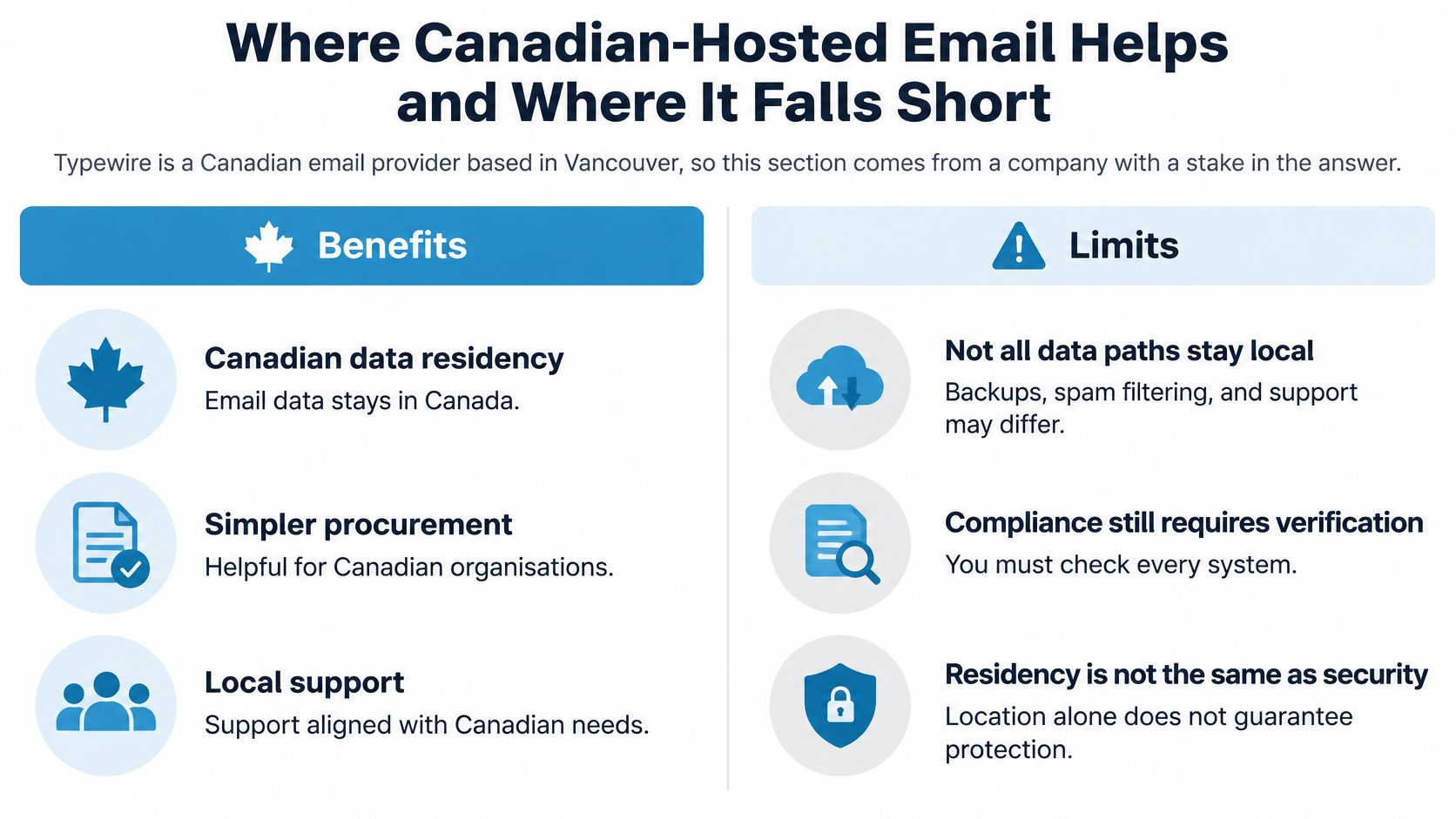
Domestic hosting can narrow the foreign jurisdictions you need to assess and simplify your privacy notices. It can also help you meet client requirements without building exceptions into each contract.
Benefits you can explain to clients
Clear location commitments make it easier to describe how you handle information. In the Office of the Privacy Commissioner's 2024 business survey, 67% of the 26 companies reporting cross-border transfers said they informed customers that their information might leave Canada. That small group illustrates a real communication task, not a national measure of where all businesses store data.
We store customer data only in Canada and operate under PIPEDA. Our infrastructure runs on privately owned servers without third-party cloud technology or APIs. Confirm those commitments in writing when you assess us, just as you would assess another provider.
Limits that still need technical work
Hosting location doesn't replace staff training, access restrictions or a sound encryption design. Nor does a provider's domestic incorporation tell you whether it uses foreign subprocessors.
Pretty Good Privacy, or PGP, is a method of encrypting and signing messages. It can protect content in a different way from server-disk encryption, but key handling adds work for users. Neither approach automatically conceals all addressing information or protects an already compromised device.
Smaller, email-focused services may also offer fewer integrations than a broad productivity suite. That trade-off can suit someone who wants less complexity, while frustrating a business that depends on tightly connected document and scheduling tools.
For sensitive records, choose the controls you can verify, not the largest collection of privacy labels.
Our opinion is that domestic residency and good contracts can be a reasonable starting point for many small organizations. Health records, legal files and other highly sensitive material deserve a stricter review of access, encryption and professional obligations.
Choose the service whose limits your team understands and can manage.
How to Verify Where Your Provider Stores Data
Start by reading the governing-law clause and checking for a foreign parent company. Ask every provider, including us, to put ownership and no-US-ties commitments into the contract rather than leaving them only on a website.
A specific facility location is a good start, but your review should still cover access, recovery and disclosure procedures, including ours.
Build an evidence file
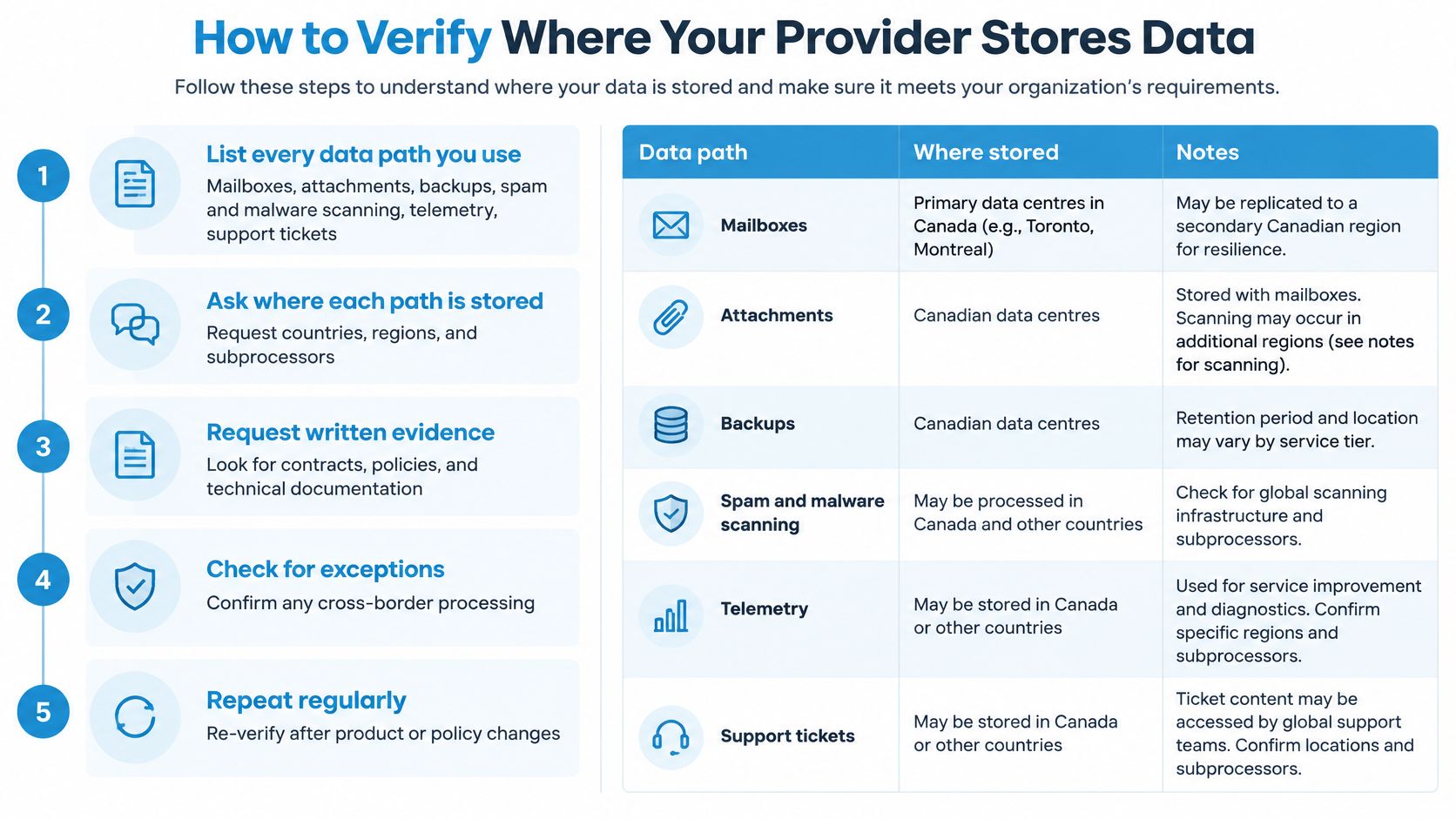
List every data path. Include mailboxes, attachments, contacts, backups, scanning, telemetry, support tickets and disaster recovery.
Locate each facility and operator. Request storage and processing locations, infrastructure ownership and subcontractor details.
Check the legal structure. Match the contracting entity to its parent companies and governing-law terms.
Examine key custody. Establish who holds encryption keys and whether the provider can decrypt content.
Read the disclosure procedure. Check legal review, foreign-request handling and customer notification where permitted.
Confirm incident commitments. Make sure the provider supplies information you need to fulfil your breach-response duties.
Save dated evidence. Keep contracts, policies and technical answers together, and review them after material changes.
Match each answer to a document
The Government of Canada's Digital Sovereignty Framework emphasizes dependencies, security, privacy and contractual controls alongside location. Use the table to turn those concerns into evidence requests.
Email data paths and the evidence to request
| Data path | Question to ask | Evidence to request |
|---|---|---|
| Primary mailbox storage | Which facilities hold mailboxes, and who owns them? | Facility locations and ownership details |
| Backups and disaster recovery | Are backups and failover sites all in Canada? | Documented failover geography |
| Spam, malware and telemetry | Where is message content scanned, and by whom? | Subprocessor list with locations |
| Administrative and support access | Who can log in to mailboxes, and from where? | Access policy and access logs |
| Encryption keys | Who holds the keys, and can they decrypt content? | Key-management design summary |
| Ownership and governing law | Which parent company and law govern the service? | Terms of service and corporate structure |
| Legal demand process | How are foreign and domestic requests handled? | Written disclosure policy |
For a broader purchasing assessment, use our guide to evaluating email hosting providers in Canada. Businesses can host their domain in Canada and manage users with Typewire; verify the commercial arrangement alongside your technical requirements.
If a provider can't answer a relevant row in writing, treat that gap as a reason to look elsewhere for sensitive email. You need evidence you can show a client or regulator, not confidence you can't explain.
We offer email hosted on our own infrastructure in Canada, with custom-domain support for businesses that want clearer control over their communications. Start your 7-day Typewire free trial, then bring this checklist to your review so your choice rests on documented commitments.
The post Data Sovereignty in Canada: Why Where Your Email Is Stored Matters appeared first on Typewire.
Data Sovereignty in Canada: Why Where Your Email Is Stored Matters
Posted: 2026-11-17
What Is Email Spoofing? How Attackers Fake Your Sender Address
Posted: 2026-11-13
Should You Get a Custom Domain for Personal Use?
Posted: 2026-11-10
Who Writes Typewire’s Code? People.
Posted: 2026-11-07
Zero-Day Attacks Explained: What They Are and Why Your Email Is a Target
Posted: 2026-11-06
Dark Web Monitoring: How to Check If Your Email Was Exposed in a Data Breach
Posted: 2026-11-03
What Is Credential Stuffing and How Does It Threaten Your Email Account?
Posted: 2026-10-30
What Is a Data Breach? How Exposed Email Credentials Put You at Risk
Posted: 2026-10-27
What Is Social Engineering? How Hackers Target Your Email
Posted: 2026-10-23