Personal Data Privacy: Why Your Email Is the Master Key to Your Digital Life
Your email does more than send and receive messages. It’s the password reset for your bank, your streaming accounts, your social media, your health apps. Every “forgot your password?” request lands in your inbox. That makes it the master key to your entire digital life, and it’s exactly why personal data privacy matters far more than most people realise.
The question worth asking isn’t whether companies collect your data. They do. The better question is what they do with it, why they want it, and what real data ownership looks like in practice. Our CEO, Bill White, sat down with tech reviewer Chris Green to get into all of that. Watch the full conversation below, then read on for a breakdown of the key takeaways.
What Companies Are Actually Collecting
Most of us have a vague sense that companies collect our data. The reality is broader than most people expect. Search engines log your queries. Social media platforms track what you click, how long you linger on a post, and where your cursor moves. Apps with location services on build a detailed map of where you go and how often. If you’ve ever had Maps suggest your “preferred route” to a place you never designated, you’ve seen this in action.
Bill describes the starting point as advertising. Companies discovered they could sell more targeted ads if they knew more about you, so the data collection expanded to match the opportunity. As he explains, the more they collect, the more precisely they can influence what you buy, read, and believe. And the boundary between “collection for ads” and “collection for everything else” has blurred significantly over time.
Why They Want Your Data
Targeted advertising gets the conversation started, but it doesn’t tell the full story.
Bill walks through a progression that begins with ads and moves into social engineering. Platforms don’t just surface things you’ll like. They also surface things designed to shape your decisions, your mood, your worldview. That’s a meaningful distinction: one is personalisation, the other is manipulation. And according to Bill, it’s always in service of influencing your choices.
Then there’s AI. The data companies have collected over decades, including your emails, search history, photos, and messages, is being used to train machine learning models. The bigger the dataset, the better the model. That’s part of why the appetite for user data hasn’t slowed down.
Breaches add another dimension. When a major provider is compromised, attackers walk away with years of personal history they can use to craft convincing phishing attacks. Bill cites Yahoo as the most-breached major email provider. If you’ve held an account there, your data has almost certainly been exposed multiple times. That treasure trove of information gives bad actors everything they need to target you with sophisticated fraud.
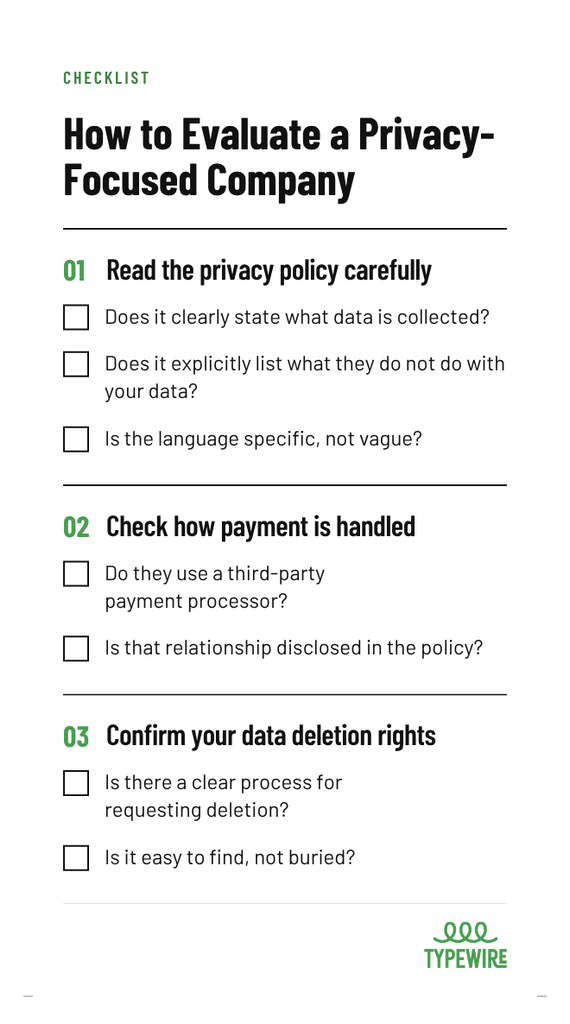
How to Evaluate a Privacy-Focused Company
If big tech companies have already burned your trust, it’s fair to wonder whether a smaller, privacy-focused company is any different. Bill’s answer is: look at the evidence they give you, not just the promises.
Start with the privacy policy and read it properly. A legitimate policy tells you clearly what the company collects, how it uses that data, and, just as importantly, what it explicitly does not do. Vague language is a red flag. Specificity is a good sign. A company serious about your data ownership should be able to say “we don’t do X, Y, and Z” without hedging.
Look at how payment is handled. Most legitimate privacy-focused companies don’t process credit cards directly. They use a third-party processor, and that arrangement should be disclosed in the policy. If a company is murky about how it handles payment data, that’s worth noting.
Finally, check for data deletion rights. You should be able to find, somewhere in the policy, a clear statement about your right to request deletion and the process for doing so. If that’s absent or buried, it may signal the company isn’t as aligned with your interests as it claims.
Personal Steps to Take Back Control
You don’t need a full lifestyle overhaul to start reclaiming your data ownership. Bill’s recommendations are practical and stackable.
Move away from free services where you can. Free services aren’t free. They’re funded by your data. If a company provides something at no cost, data monetisation is almost certainly part of the model. Paid services with a clear subscription model are more aligned with your interests because your payment is what sustains the business, not your profile.
Enable multi-factor authentication and update your passwords. This is basic hygiene that a surprising number of people still skip. Multi-factor authentication makes it significantly harder for bad actors to access your accounts even if they have your password. It’s one of the simplest upgrades you can make.
Delete apps you don’t use. Every unused app with permissions is a passive data collection point. If you’re not using the service, log into the account, delete your data, and close it if you can. If there’s no self-serve delete option, contact the company directly and request data deletion. You have the right to ask, and reputable companies are obligated to comply.
Cut back on social media. Every click, scroll, and like feeds the algorithm and adds to the profile these platforms build on you. Reducing the signal you send them also reduces what they can collect and sell.
Email is where most people’s digital life is organised, so it’s a good place to start. Switching to a private provider that doesn’t scan your messages, mine your data, or deliver ads is a meaningful step toward real data ownership. You can read more about how Typewire handles your data on our privacy features page.
Try Typewire
Typewire is a Canadian private email provider built for people who want their inbox to stay private. We own our infrastructure, host all data in Canada under PIPEDA protection, and make money through subscriptions, not your data. If you’re ready to start taking personal data privacy seriously, the inbox is a good place to begin. Try Typewire free for 7 days.
Frequently Asked Questions
What is personal data privacy and why does it matter?
Personal data privacy is your right to control what information about you is collected, how it’s stored, and how it’s used. It matters because the data companies collect influences your choices, funds their advertising operations, trains AI models, and, when breached, exposes you to fraud and identity theft. It’s not about having something to hide. It’s about control over your own information.
Is my data really at risk if I have nothing to hide?
Yes. The risk isn’t about concealing wrongdoing. It’s about exposure to fraud, phishing, and identity theft. When major providers are breached, attackers use that data to build convincing scams targeting real people. Your email history, contact list, and personal details have value to bad actors regardless of whether you’ve done anything worth hiding.
What makes an email provider genuinely privacy-focused?
A legitimate privacy-focused provider should have a clear policy specifying what data it does not collect, disclose how payment is handled, and include a defined process for data deletion. Look for transparency about infrastructure and data residency. In Canada, PIPEDA governs how companies must handle personal information, so any provider operating here should be able to explain their compliance clearly.
Why does it matter where my email is hosted?
If your email is on servers in the United States, it may be subject to US laws, including those that allow government agencies to access data without notifying you. Email hosted in Canada falls under PIPEDA and Canadian jurisdiction, which carries different protections. For Canadian individuals and businesses, data residency is a meaningful part of personal data privacy.
How do I start taking back control of my data?
Start with email. Move to a paid provider that doesn’t monetise your data. Then enable multi-factor authentication on all your accounts, audit your installed apps and remove the ones you don’t use, and request deletion of accounts you’ve abandoned. Reducing your social media activity also reduces the data you’re producing for platforms to collect and sell.
Is it too late to reclaim data ownership?
It’s not. You can’t retrieve data companies have already collected, but you can stop adding to it and request deletion in many cases. PIPEDA gives Canadians the right to request access to their personal data and to have it corrected or deleted. Taking steps now limits your future exposure, even if the past is already out there.
The post Personal Data Privacy: Why Your Email Is the Master Key to Your Digital Life appeared first on Typewire.
Personal Data Privacy: Why Your Email Is the Master Key to Your Digital Life
Posted: 2026-09-24
Personal Data Privacy: Why Your Email Is the Master Key to Your Digital Life
Posted: 2026-09-24
Secure Email Gateway Guide: Do You Need One?
Posted: 2026-09-23
Average Email Deliverability Rate: 2026 Benchmarks
Posted: 2026-09-18
Phishing vs Spam: What’s the Difference?
Posted: 2026-09-15
PIPEDA vs GDPR Key Differences for Businesses
Posted: 2026-09-11
CASL Express vs Implied Consent: What’s the Difference?
Posted: 2026-09-08
Moving Away from Big Tech Email and How to Make the Transition Smooth. Here’s How:
Posted: 2026-09-04
Why Choose Typewire as a Canadian Email Option
Posted: 2026-09-01