What is email encryption? A Practical Guide for 2026 Security
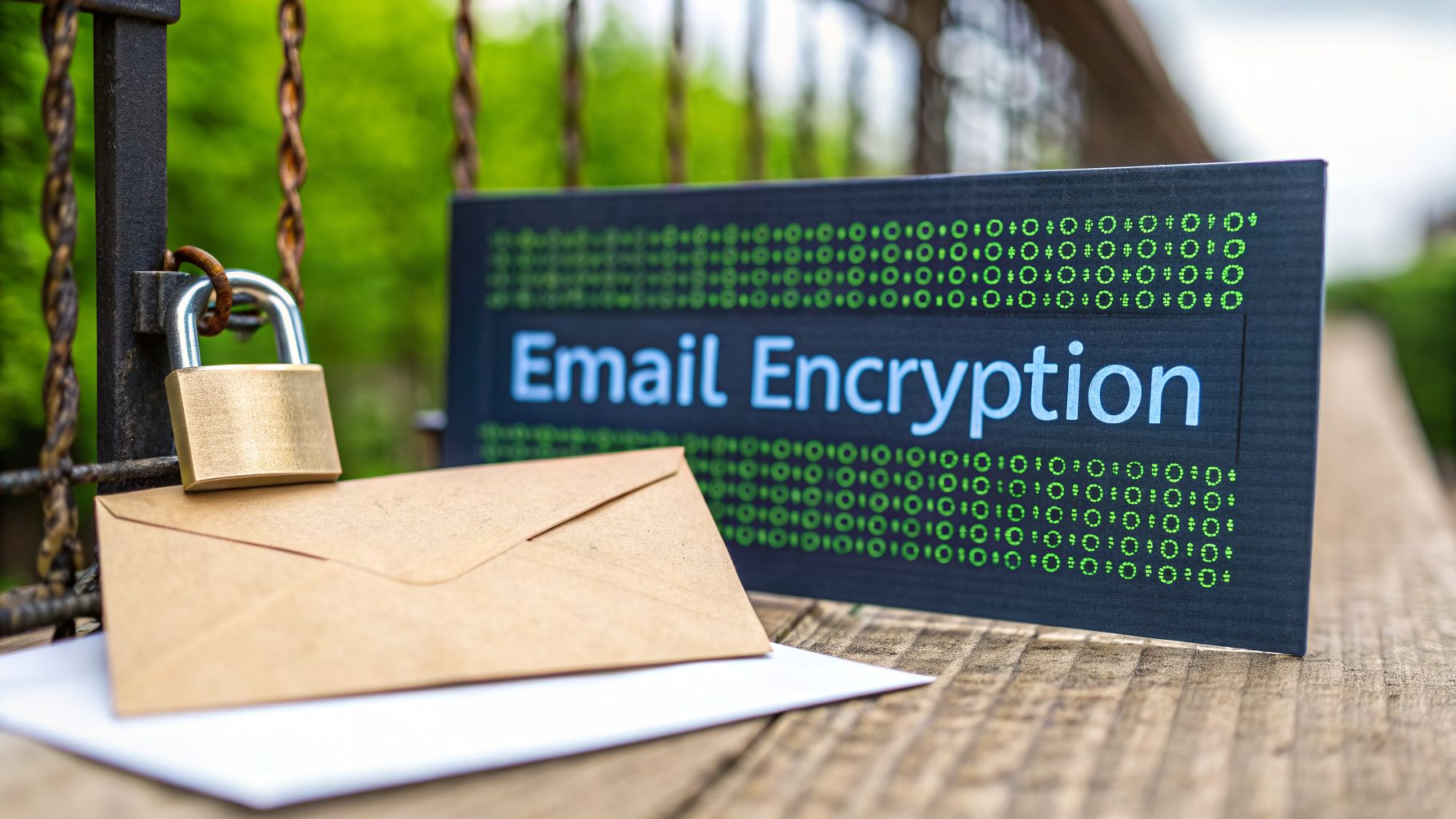
Email encryption is what turns your messages from digital postcards into sealed, tamper-proof letters, protecting your email privacy and bolstering your email security with every message you send.
Your Digital Postcard vs. Your Sealed Letter
Think about the last email you sent. Did you know it travels across the internet a lot like a postcard? Anyone handling it along the delivery route—from your internet provider to ad-tech companies and government agencies—can easily peek at its contents.
That’s the unfortunate reality for most emails sent today, especially through many popular free hosted email platforms. This gaping security hole means your sensitive personal details, confidential business plans, and private attachments are exposed. It's a common but dangerous misconception that our digital conversations are private by default.
In reality, an unencrypted email is an open book. It lays your private life and business communications bare for anyone with access to the servers it passes through on its journey.
Understanding the "Sealed Letter"
This is where email encryption comes in. It acts as a digital seal, scrambling your message into unreadable code before it even leaves your computer. Only the intended recipient, who holds the unique corresponding "key," can unlock and read the original message, guaranteeing email privacy.
Even if a third party manages to intercept your email, the contents remain gibberish. This simple but powerful process provides three core email security protections:
- Confidentiality: It stops prying eyes from reading your private communications. This is the foundation of email privacy.
- Integrity: It guarantees the message you receive is the exact same one that was sent, with no tampering in between.
- Authentication: It helps verify the sender is who they claim to be, a massive defence against phishing attacks.
To truly get the "sealed letter" effect, you need what's known as end-to-end encryption (E2EE). This is the gold standard for email security, ensuring that from the moment you hit "send" until your recipient opens the email, no one else—not even your email provider—can access the content. That’s why choosing a hosted email platform with this protection built-in is so critical for safeguarding your email privacy.
The Two Main Types of Email Encryption Explained
When people talk about email encryption, it's easy to assume it’s all the same. But in reality, not all encryption offers the same level of email security. There are two main approaches, and understanding the difference is key to knowing how truly private your emails are.
Think of it like this: you can send a package in an armoured truck, or you can put that package inside a locked safe before it even goes in the truck. These are the two worlds of email encryption: Transport Layer Security (TLS) and End-to-End Encryption (E2EE).
Transport Layer Security (TLS): The Armoured Truck
Most of the email you send today is protected by Transport Layer Security, or TLS. This is the industry standard for basic email security. It essentially creates an encrypted, private tunnel between your device and your email server, and then between all the servers your email hops across on its way to the recipient.
This is the "armoured truck." It's great at preventing eavesdroppers from intercepting your message while it's travelling across the internet. Without TLS, your email is like a postcard that anyone can read along the delivery route.
The catch? Once the armoured truck reaches the mail sorting centre—the email provider's server—the message is taken out, decrypted, and stored. This means your email provider (like Gmail or Outlook) can see and scan the contents of your messages. So while TLS protects your email in transit, it compromises your email privacy by leaving it exposed at rest on the server.
End-to-End Encryption (E2EE): The Locked Safe
For genuine email privacy, you need End-to-End Encryption (E2EE). This is the "locked safe" approach.
With E2EE, your email is encrypted on your device before you even hit send. It stays scrambled and completely unreadable to everyone—including your email provider, server administrators, and any government agencies—while it travels. Only the intended recipient, who has the unique corresponding key, can unlock and read it on their device.
Your email provider just sees a garbled mess of data. They can't scan it, analyze it, or hand over its contents because they never have the key to decrypt it.
End-to-end encryption is the gold standard for email security because it removes trust from the equation. It technically guarantees that only you and your recipient can ever read the message, making it the only real choice for protecting sensitive information and ensuring true email privacy.
This is the difference between an email that's private in transit versus one that's private, period.

The technologies that make this possible, like PGP (Pretty Good Privacy), have been around for decades and are the foundation of modern secure communication. You can learn more about how it works in our guide to PGP encryption online.
Thankfully, you no longer need to be a technical wizard to use it. Many privacy-first hosted email platforms now build E2EE directly into their services, giving you the ironclad email security of the locked safe with the simple convenience of a modern inbox.
Why Email Encryption Is Non-Negotiable in 2026

The days of treating email encryption as an optional extra are long gone. As cyberattacks grow more common and far more sophisticated, we have to see email security for what it is: a fundamental necessity for everyone, not just a niche tool for tech experts.
Think about your inbox for a moment. If it’s unencrypted, it’s like leaving your front door unlocked. It's a wide-open invitation for criminals to walk right in and rifle through your most sensitive information—a major threat to your email privacy. It’s no surprise that so many of today's most damaging cyberattacks start with a single, unprotected email.
Email encryption is no longer just about privacy; it's about survival. It acts as your first and last line of defence against data breaches, corporate espionage, and financially devastating ransomware attacks, forming the bedrock of modern email security.
The Rising Tide of Cyber Threats
Ransomware has become an especially nasty threat for individuals and organizations alike. These attacks are often initiated through simple phishing emails, where one wrong click on a malicious link can lock down an entire network, holding its data hostage. Here in Canada, the problem is getting worse, fast.
The Canadian Centre for Cyber Security has seen a startling 26% average year-over-year jump in known ransomware incidents from 2021 to 2024. When you consider that the average ransomware payout in North America now tops CAD 1.5 million per incident, the potential for financial and operational ruin is staggering. For more on this, check out the full threat outlook from the Canadian government. Encrypting your email makes it a much tougher target and a far less effective entry point for these attacks.
Compliance and Financial Consequences
It isn't just cybercriminals you have to worry about. There are significant legal and financial pressures to protect data, and for Canadian businesses, this isn't just a recommendation—it's the law. A good cloud service security checklist will always highlight encryption as a critical component for safeguarding communications and maintaining modern operational standards.
Here’s why compliance alone makes encryption essential for email security:
- PIPEDA Requirements: Canada's Personal Information Protection and Electronic Documents Act (PIPEDA) is clear. It requires organizations to use appropriate security safeguards to protect personal information. Failing to do so can lead to massive fines and crippling reputational damage.
- Protecting Client Trust: A data breach can instantly destroy the trust you've worked so hard to build with your clients and partners. By embracing encrypted email, you’re sending a clear signal that you take their email privacy and security seriously.
- Avoiding Financial Penalties: Fines for non-compliance under PIPEDA can be as high as CAD 100,000 for every single violation. For a small or medium-sized business, a penalty like that could be a death sentence.
Ultimately, you have to view email encryption as a critical investment in your digital life. It’s a powerful shield in a hostile digital world, a key to meeting your legal duties, and a safeguard for your financial stability and hard-earned reputation. In 2026, neglecting email security is simply not an option.
Hosted vs. Self-Managed Encryption: Which Path Is Right for You?
Knowing you need to encrypt your email is the first step. The next is figuring out how. When it comes to actually protecting your communications, you’re looking at two main paths: the do-it-yourself, self-managed route, or using a dedicated hosted email platform.
Each approach strikes a different balance between control, convenience, and the technical skill required to get the job done right. Let's break down what each one really means for your email privacy and email security.
The DIY Route: Self-Managed Encryption
The self-managed option usually means using established protocols like PGP (Pretty Good Privacy) or S/MIME. You're responsible for setting everything up yourself within a standard email client, like Outlook or Thunderbird.
This approach puts you in the driver's seat. You have absolute control over your encryption keys and the entire security process. But with that power comes a whole lot of responsibility.
Think of the self-managed path like being your own master locksmith. You forge the keys and install the locks yourself, but you're also solely responsible for keeping them safe and using them correctly. One mistake, and you've left the door to your private communications wide open.
The Reality of Managing Your Own Encryption
Frankly, going it alone is not for the faint of heart. It demands a serious level of technical know-how. You'll need to generate your own keys, manage them securely, and then figure out a safe way to exchange public keys with every person you want to communicate with.
A single slip-up, like losing your private key or accidentally exposing it, could mean losing access to your encrypted messages forever—or worse, compromising your entire communication chain.
- High Technical Barrier: This isn't just plug-and-play. It requires a solid understanding of cryptography and key management.
- Constant Maintenance: You're the one on the hook for software updates, key rotations, and fixing compatibility problems.
- User Experience Headaches: The biggest challenge is often getting other people on board. Convincing less technical contacts to adopt and correctly use the same system can be a huge, often insurmountable, obstacle.
The Simpler Path: A Hosted Privacy Email Platform
On the other end of the spectrum, you have hosted email platforms that prioritize privacy. These services are designed to make strong encryption accessible to anyone, regardless of their technical skill.
Services like Typewire build end-to-end encryption right into the platform, automating all the complex work. Key generation, exchange, and management all happen behind the scenes, without you ever having to think about it. It’s essentially a "set it and forget it" solution for true email privacy and email security.
This approach removes the steep learning curve and the significant risk of user error. Instead of wrestling with keys and configurations, you can just focus on communicating securely. If you're weighing the options for your organization, our guide on choosing an encrypted email solution for your business can help you navigate the decision.
When you're evaluating these platforms, look for a provider that offers a zero-access architecture. This is a critical design principle which guarantees that the provider themselves can never access or decrypt your emails. All the magic happens on your device, ensuring only you and your intended recipient can ever read the message content.
Another important factor for email privacy is Canadian data residency. Choosing a service based in Canada places your information under the protection of strong privacy laws like PIPEDA, shielding it from the overreach of foreign governments. A good hosted email platform makes top-tier security the default, not a feature you have to struggle to implement.
The Power of a Private Email Ecosystem

While strong end-to-end encryption is the heart of any email security plan, real digital privacy is about more than just one powerful lock. It’s about building a complete, secure ecosystem where every single piece is designed to protect you. This is what truly separates standard email from a private communication channel offered by a dedicated hosted email platform.
Think of it like building a fortress. Your encryption is the impenetrable steel door, but what about the walls, the guards, and the lookout towers? A private email provider builds these extra layers of security for you, creating a unified defence against all kinds of digital threats to your email privacy.
Beyond the Encrypted Message
The foundation of this ecosystem is something called zero-access architecture. At its core, this is a simple promise: not even the email provider can read your messages. All the scrambling and unscrambling of your emails happens right on your device, which means your data is completely unreadable on the server.
Another key piece of the puzzle is privately owned infrastructure. When a hosted email platform owns and operates its own servers instead of renting space from a third-party giant like Amazon or Google, they have total control over the environment. This simple step eliminates the risk of another company’s lax security or invasive policies compromising your privacy.
A private email ecosystem means your provider respects your email privacy at every level. It's a commitment that goes beyond just scrambling message content to actively safeguarding your entire email experience from prying eyes.
Proactive Defences for Complete Privacy
A truly private email service also goes on the offensive, building in defences that shield you from modern surveillance tricks. These features all work together to put a robust shield around your inbox, enhancing both email security and email privacy.
- Blocking Spy Pixels and Trackers: Countless marketing emails hide invisible tracking pixels that tell the sender when, where, and on what device you opened their message. A private email provider automatically blocks these trackers, slamming the door on this kind of surveillance.
- Secure Data Residency: Choosing a provider based in a country with strong privacy laws adds a powerful legal shield. For example, hosting your data in Canada places it under the protection of PIPEDA, keeping it out of the reach of foreign government surveillance programs.
- Protecting Your Identity with Aliases: Email aliases are disposable addresses that forward to your main inbox. You can use them to sign up for services without ever giving out your real email, which dramatically cuts down on spam and protects your true identity from data breaches.
These features are non-negotiable because they tackle the full spectrum of email security threats. Here in Canada, regulations like PIPEDA have pushed organizations to take email security seriously, especially with non-compliance fines that can hit CAD 100,000 per violation.
But security is useless if it’s too hard to use. Studies have shown that a staggering 66% of users will simply give up on complex encryption setups. This is where hosted email platforms shine—they build these features right in, making top-tier security feel effortless. You can check out a full comparison in our guide to private email hosting services. These integrated tools are becoming essential, with sectors like healthcare and finance leading the way.
Answering Your Top Email Encryption Questions
Diving into email encryption can bring up a lot of practical questions. You’ve got the basics down, but what does it all mean when you’re actually sitting in front of your inbox? Let's clear up some of the most common points of confusion around email security and email privacy.
Think of this as the real-world guide to using encrypted email, moving beyond theory and into how it impacts your day-to-day communication.
Can I Send an Encrypted Email to Someone Who Doesn't Use Encryption?
This is one of the biggest hurdles people think of, and the answer isn't a simple yes or no. It really depends on how you're encrypting your message.
If you’re using traditional end-to-end encryption (E2EE) like PGP, then no, you can't. Both you and your recipient absolutely must have the right software and keys set up beforehand. It's like sending a message in a secret code; if your friend doesn't have the decoder ring, all they get is a bunch of nonsense.
This is where a modern hosted email platform comes in with a smart workaround. Many private email services let you send a password-protected, encrypted message to any email address out there. Your recipient gets a notification with a secure link. Clicking it takes them to a private web page where they simply enter a password you've shared with them (over the phone or text, for example) to unlock and read the message. It's a clever way to ensure email security without making the other person overhaul their whole email setup.
Of course, standard encryption in transit (TLS) is already working behind the scenes between most email providers. This protects the "delivery route," but the email itself can be read by the servers on either end.
If My Email Is Encrypted Am I Completely Anonymous?
No. This is a crucial distinction. Email encryption protects the content of your message, not your identity. Email privacy and anonymity are two very different things.
Even when you use the strongest end-to-end encryption, a trail of information called metadata is always left behind. This includes things like:
- Your email address (the sender)
- The recipient's email address
- The subject line
- The time and date the email was sent
- The IP address your computer used to send it
This metadata can paint a surprisingly detailed picture of who you talk to, when, and how often—even if no one can read what you're saying. Encryption secures what you said, but not the fact that you said it. Your email privacy is enhanced, but you are not anonymous.
To achieve real anonymity, you would need to layer other tools on top of your encrypted email, like using the Tor network to obscure your location and IP address.
Does Email Encryption Slow Down My Email?
For virtually everyone, the answer is no. Any performance hit from modern email encryption is so tiny it’s impossible to notice.
While the math involved in scrambling and unscrambling your data (the cryptography) does take a little bit of processing power, today's computers and smartphones are more than powerful enough to handle it in a fraction of a second.
When you use a quality hosted email platform, the encryption is built right into the app. It's so seamless and optimized you'll likely never know it's even happening. The massive boost to your email security and email privacy is well worth the microscopic, and usually unnoticeable, trade-off.
Why Should I Use a Canadian Hosted Email Provider?
Choosing a Canadian-hosted email provider gives your data some very specific and powerful layers of protection, directly boosting your email privacy. Your information is automatically covered by one of the world's stronger privacy laws: the Personal Information Protection and Electronic Documents Act (PIPEDA). This act establishes a strong legal framework for how companies must handle your personal data, giving you clear rights and control.
Just as important is data residency. This means your emails, contacts, and attachments are physically stored on servers located within Canada. This keeps your data outside the direct reach of more aggressive foreign surveillance programs, such as the U.S. CLOUD Act. This combination of strong domestic laws and sovereign infrastructure creates a genuine safe harbour for your private communications, solidifying your email security posture.
Ready to take back control of your inbox with true privacy and security? Typewire offers zero-access, end-to-end encrypted email hosted on private infrastructure in Canada, protected by Canadian law. Get started with a free trial and experience an ad-free, tracker-free inbox at https://typewire.com.
The post What is email encryption? A Practical Guide for 2026 Security appeared first on Typewire.
What is email encryption? A Practical Guide for 2026 Security
Posted: 2026-03-22
How to Whitelist an Email Address (So You Stop Missing Messages)
Posted: 2026-10-06
Email Bounce Explained: Soft vs Hard Bounces & How to Fix Them
Posted: 2026-10-02
Which Secure Email Provider Fits Your Workflow? 10 Options by Use Case
Posted: 2026-09-29
Personal Data Privacy: Why Your Email Is the Master Key to Your Digital Life
Posted: 2026-09-24
Secure Email Gateway Guide: Do You Need One?
Posted: 2026-09-23
Average Email Deliverability Rate: 2026 Benchmarks
Posted: 2026-09-18
Phishing vs Spam: What’s the Difference?
Posted: 2026-09-15
PIPEDA vs GDPR Key Differences for Businesses
Posted: 2026-09-11